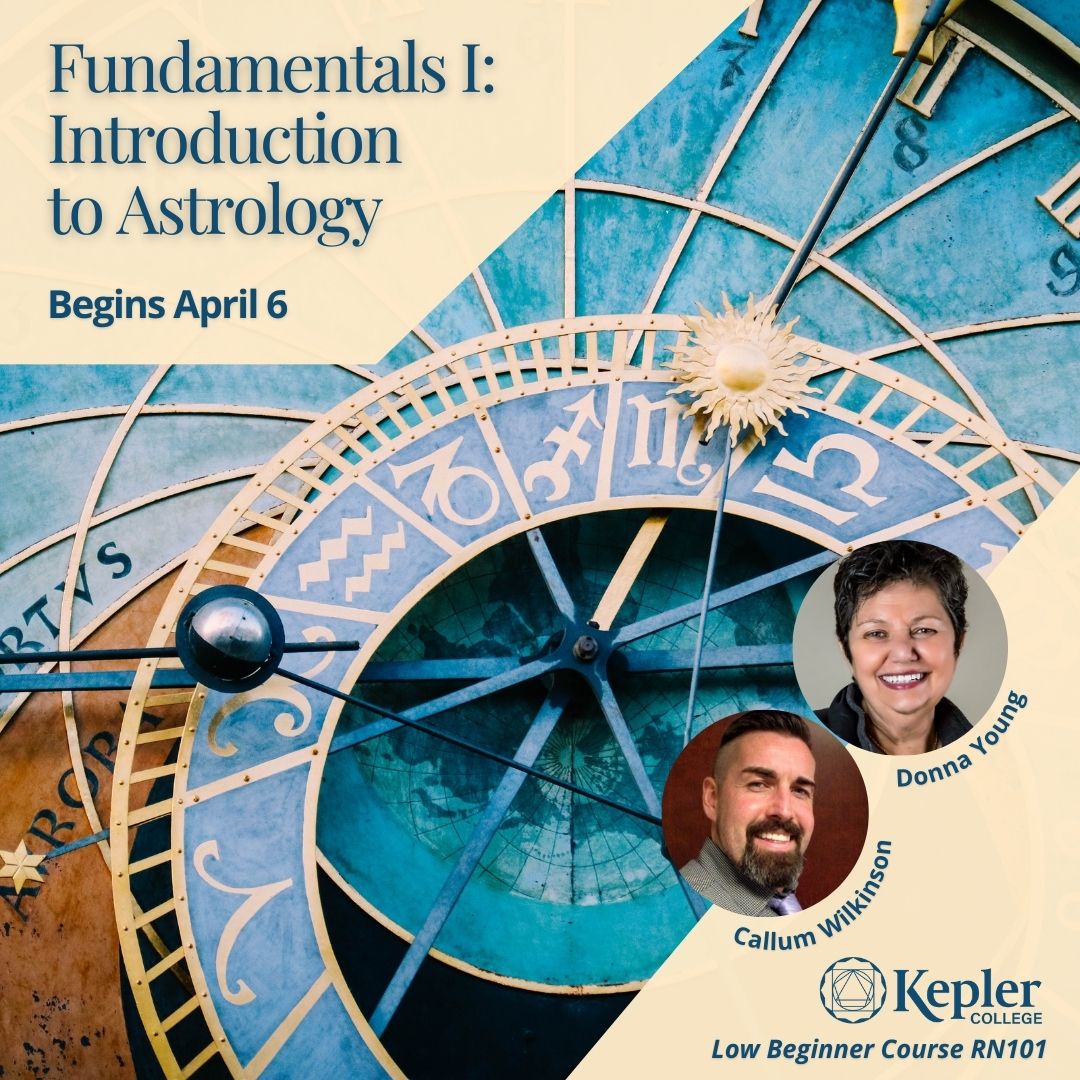
Fundamentals I: Introduction to Astrology

Fundamentals I: Introduction to Astrology

This course is designed for students who know the very basics of astrology and/or want to solidify the astrological knowledge they have already gained on their own.

The astrological chart will be taken apart in order for students to clearly understand how each set of symbols functions and how their interaction provides the basis of interpretation.

Students in this course will not only build a solid understanding of the basics of astrology but learn how to immediately apply what they learn to chart interpretation, even if there is no birth time.

This course requires Low Beginner Astrological Knowledge.

Click here to check your astrological skill set

If you have a background in astrology you can challenge this course:

https://store.keplercollege.org/category/courses-by-type/challenge-tests/

This is one of two RN101 courses offered on different days; for an alternate class time, click here.

Instructors: TBA
RN101 (10 weeks) – Spring 2025-26
Class begins April 6, 2026
Advance pricing until March 23, 2026

Original price was: $590.00.Current price is: $560.50.

32 in stock

Pay in Full Pay with Payment Plans

Buy Now

Description

Instructors: TBA
Day: Monday, beginning April 6, 2026*
Time: TBA
Course Length: 10 weeks – all live classes are recorded
*Additional Practice Labs will be offered throughout the course


This course is designed to introduce students to the core components of the natal chart and how these individual pieces combine for interpretation. By the end of this course, students will have worked with essential techniques for chart interpretation and can identify the strengths and weaknesses of different approaches. Students will be able to synthesize these core astrological components into a basic coherent and meaningful interpretation without relying on outside resources.

What You’ll Learn: 

  • An introduction to the astronomical underpinnings of the astrological chart
  • Exploration of the interplay between astronomy and the astrological meanings of the planets; comparing meanings from Hellenistic to modern; and an introduction to the mythology and archetypal meaning of the planets
  • Introduction to natal retrograde planets and meaning
  • Understanding the big picture by working with elements, modes, and polarities; the hemispheres and quadrants, and Marc Edmund Jones modern chart patterns
  • Examining the construction of meaning within the astrological signs
  • Introduction to the astrological houses and how they are created; the meanings of the houses and their changes over time; how to use the houses to enhance an interpretation
  • Introduction to the major aspects
  • Introduction to basic dignities, debilities, and dispositor trees to help hone chart interpretation
  • Layering all this together to create your own interpretation without any outside resource


By the end, students will have a solid understanding of the planets and how the signs and houses modify their meaning. They will learn to evaluate what planets are highlighted in the chart based on their placement by sign and house, basic dignities, and their interaction through aspects and dispositors. They will be able to synthesize this information into a basic coherent and meaningful interpretation without relying on outside resources.

Weekly Topics:

  1. Introduction: The Big Picture & The Lights
  • What do we mean when we talk about an astrological chart?
  • How do Western tropical astrologers map an astrological chart
  • Introduction to the astronomy of the solar system
  • What is included in an astrological chart
  • Data quality
  • Begin to understand the basic functions of the Sun and Moon


  1. The Visible Planets
  • Begin to understand the basic functions of Mercury, Venus, Mars, Jupiter, and Saturn
  • Start to form your own relationships with how the planets function in your a chart and how they can be reflected in imagery, poetry, TV programs, etc.
  • Begin the process of translating the keywords for the planets into the ordinary “livingness” of human beings.


  1. The Outer Planets
  • Begin to understand the basic functions of Uranus, Neptune, and Pluto
  • Learn how these slower-moving planets affect larger groups of people
  • Explore what was going on in history while these planets moved through signs in order to understand the future better


  1. Signs by Element, Mode, & Polarity
  • Understand the core meaning of the sign based on their original divisions by polarity, element, and mode.
  • Learn how elements and modes modify the meaning of the planets
  • Begin to understand and distinguish the relationships between planets and signs
  • Learn about planetary rulers (planets at home in a sign)
  • Practice working with foundational energy/chart signature


  1. Planets in Signs
  • Begin to synthesize the meaning of planets in signs to form meaningful sentences


  1. Quadrants, Hemispheres, Angularity
  • Understand the basic astronomy behind the ascendant and midheaven
  • Understand how the chart is organized by time
  • Become familiar with the different divisions of the chart created by the ascendant and midheaven
  • Define angular, succedent and cadent, house cusps


  1. Houses
  • Learn astrological symbolism and keywords for the houses
  • Practice synthesizing the meaning of planets and signs in the houses
  • Begin to understand where to look in the chart to answer different questions


  1. Rulership & Dispositor Patterns
  • Learn dispositors and dispositor trees
  • Begin expanding your interpretation by considering the placement of house rulers and dispositors.


  1. Major (Ptolemaic Aspects)
  • Learn how the angular relationship between planets adds to interpretation.
  • Understand how the divisions by 1, 2, and 3 form the major (Ptolemaic) aspects
  • Analyze the aspects based on the relationship of the signs to each other by polarity, element, and mode
  • Develop interpretative skills by considering the difference between hard and soft aspects


  1. Putting It Together
  • Put weeks 1 to 9 into practice
  • A look at all the ways we have explored how planetary meaning is modified by additional considerations.
  • Chart synthesis
  • Final Exam


This course is required for the Professional Diploma

Prerequisites:

This course requires Low Beginner Astrological Knowledge.

Click here to check your astrological skill set

If you have a background in astrology you can challenge this course:

https://store.keplercollege.org/category/courses-by-type/challenge-tests/

Required Texts:

  • Gillett, Roy: The Secret Language of Astrology
  • Houlding, Deborah: The Houses, Temples of the Sky
  • Tompkins, Sue: Aspects in Astrology
  • Avelar, Helena, and Luis Ribeiro, On the Heavenly Spheres: A Treatise on Traditional Astrology OR
  • Obert, CharlieIntroduction to Traditional Natal Astrology: A Complete Working Guide for Modern Astrologers


Cancellation and Refund Policy


Registration closes at 7:00am on Thursday April 9th, 2026

Reviews

There are no reviews yet.

Be the first to review “Fundamentals I: Introduction to Astrology”